
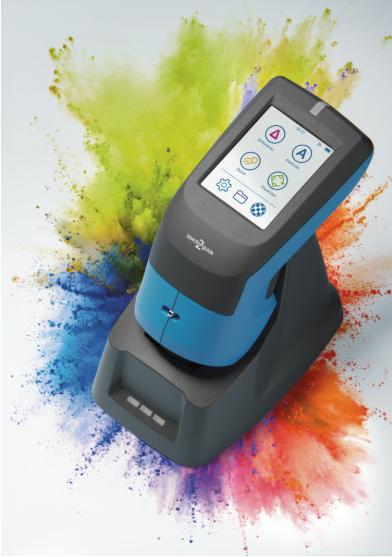
A spectrophotometer is an instrument that measures how much light a surface reflects at each wavelength of the visible spectrum (about 400–700 nm), then calculates objective colour values such as L*a*b* and the colour difference ΔE. In short, it turns "colour" — normally subjective — into numbers that are measurable, repeatable and comparable, the foundation of colour quality control (colour QC) in paint, plastics, automotive, wood and printing.
How does a spectrophotometer work?
The instrument shines a standard light source on the sample, uses a diffraction grating to split the reflected light into its wavelengths, and measures them with a sensor array. The result is a spectral reflectance curve — the sample's "colour fingerprint." From this curve, the software computes the L*, a*, b* coordinates and the colour difference ΔE against a standard, under several illuminants (D65, A, F11) to detect metamerism.
What does a spectrophotometer measure?
- L*a*b* colour values and other colour spaces (XYZ, LCh).
- Colour difference ΔE (ΔE*ab, ΔE00) and pass/fail against tolerances.
- SCI/SCE modes (gloss included/excluded) on sphere instruments — see What are SCI and SCE?
- Many models also measure 60° gloss and the fluorescent component.
Types of spectrophotometer: 45°/0° or d/8°?
The biggest difference is the measurement geometry: 45°/0° reflects colour much as the eye sees it on flat surfaces; d/8° (integrating sphere) lets you choose SCI/SCE, ideal for colour formulation and glossy/curved samples. Details: 45°/0° vs d/8°. For handheld vs benchtop, see portable vs benchtop.
Spectrophotometer vs colorimeter: what's the difference?
A colorimeter measures through only three X, Y, Z filters — cheap but inflexible. A spectrophotometer measures the full reflectance spectrum, so it is more accurate, can switch illuminants/observer angles, and detects metamerism — which a colorimeter cannot.
Recommended BYK-Gardner spectrophotometers at K&K
| Need | Instrument |
|---|---|
| Standard handheld (colour + 60° gloss) | Spectro2go |
| Advanced handheld (adds fluorescence + software) | Spectro2guide |
| Benchtop for the QC lab | Color2view |