
Quick answer: Choose 45°/0° when you care about colour as the eye sees it (gloss excluded) on flat/textured surfaces. Choose d/8° when you need the flexibility to include/exclude gloss (SCI/SCE) for formulation and glossy/curved samples.
Quick comparison
| 45°/0° | d/8° | |
|---|---|---|
| Illumination | 45°, view 0° | Diffuse (sphere), view 8° |
| Gloss | Always excluded | Choose SCI or SCE |
| Reflects | Appearance as seen | Material colour (SCI) or appearance (SCE) |
| Best for | Paints, coatings, appearance | Formulation, plastics, glossy/curved |
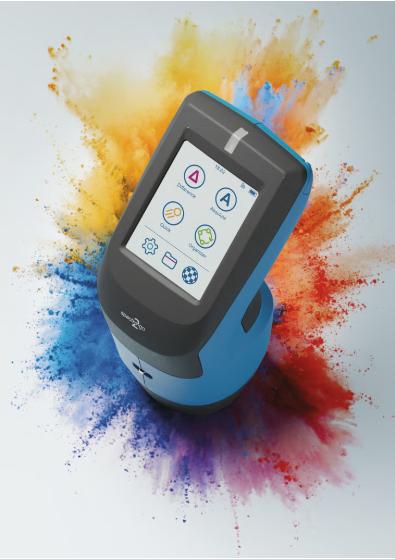
Read the deep dives: what is 45°/0° and what is d/8°. Instruments like Spectro2go offer both versions.
Frequently asked questions
Do the two geometries give different results?
Yes — the same sample can give different ΔE between 45°/0° and d/8°, especially on glossy surfaces. Standardise on one geometry across the QC chain.
If I buy only one, which?
Prioritise product appearance → 45°/0°; prioritise formulation/flexibility → d/8°. K&K advises based on your samples.
Can I compare readings between the two?
No — compare within the same geometry to avoid discrepancies.