
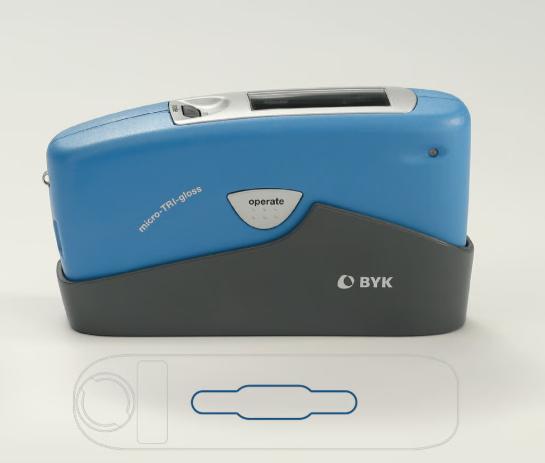
Gloss is the degree to which a surface reflects light in the specular (mirror) direction, which determines whether it looks "glossy" or "matte." Gloss is measured objectively with a gloss meter and expressed in gloss units (GU) — replacing subjective judgement with numbers that are repeatable and comparable from batch to batch.
How is gloss measured? Gloss units (GU)
A gloss meter projects a beam of light onto the surface at a fixed angle and measures the light reflected in the specular direction at the mirror angle. The reading is calibrated against a polished black-glass standard (assigned ~100 GU). The glossier the surface, the higher the GU; matte surfaces give low GU.
Gloss angle: 20°, 60° or 85°?
The measurement angle is chosen to match the sample's gloss level for best resolution:
- 60° — the general reference angle for medium-gloss surfaces.
- 20° — for high-gloss surfaces, better resolution in the glossy range.
- 85° — for matte surfaces.
How to pick the angle: How to choose a gloss meter: 20°, 60° or 85°? and single-angle or three-angle?
Gloss measurement standards
Gloss measurement follows the international standards ISO 2813, ASTM D523 and DIN 67530 — ensuring consistent results between labs, plants and customers.
How is gloss different from DOI and surface structure?
Gloss measures the amount of specular reflection but doesn't fully describe appearance. On high-gloss surfaces you also need DOI (distinctness of image) and surface structure (orange peel) — see When to measure DOI.
BYK-Gardner gloss meters at K&K
| Need | Instrument |
|---|---|
| Single angle (60°, 20° or 85°) | micro-gloss |
| All three angles 20/60/85° | micro-TRI-gloss |