
One of the most common questions when buying a gloss meter is: should you choose a 20°, 60° or 85° angle? Pick the wrong one and your readings will be insensitive and hard to control. The good news is that ISO 2813 (and ASTM D523) give a very clear rule — this article summarizes it so you get it right the first time.
What does the gloss angle mean?
A gloss meter shines a beam onto the surface at a fixed angle and measures the specularly reflected light. The angle (measured from the surface normal) determines sensitivity: a small angle is sensitive to very glossy surfaces, a large angle to matte ones. The unit is GU (Gloss Units).
The angle-selection rule in ISO 2813
Always start with 60° — it's the reference angle and works across the whole gloss range. Then use the 60° result to decide:
- If 60° reads > 70 GU (high gloss): switch to 20° for better resolution between high-gloss samples.
- If 60° reads 10–70 GU (semi-gloss): stay at 60°.
- If 60° reads < 10 GU (matte): switch to 85° for greater sensitivity in the low-gloss range.
Quick rule: 60° is the default; use 20° for high gloss and 85° for matte surfaces.
Recommendations by application
- Automotive paint, high-gloss coatings, glossy plastics: usually need both 20° and 60°.
- Architectural and semi-gloss industrial paint: 60° is enough in most cases.
- Matte paint, matt finishes, matte-coated wood, satin surfaces: need 60° and 85°.
- Checking gloss uniformity on matte surfaces: 85° reveals differences that 60° can miss.
Single-angle or triple-angle instrument?
If you only make one product type with a stable gloss range, a single-angle 60° meter is economical and sufficient. See the micro-gloss 60° gloss meter.
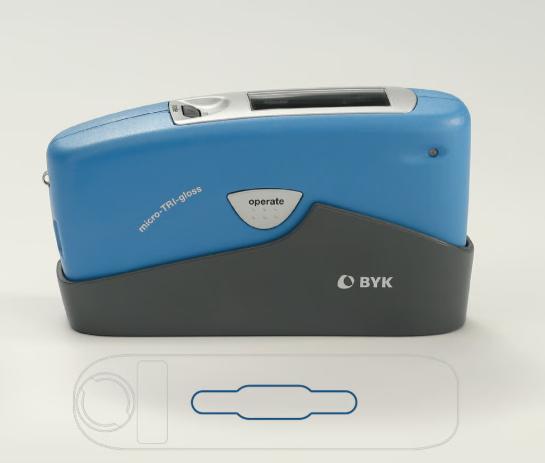
If you measure many surface types — from high gloss to matte — or want to follow ISO 2813 without swapping instruments, choose a triple-angle meter that measures 20°/60°/85° at once: micro-TRI-gloss triple-angle gloss meter. One placement gives you all three angles, saving time and avoiding mistakes.
Browse all BYK-Gardner measurement instruments for a detailed comparison.