
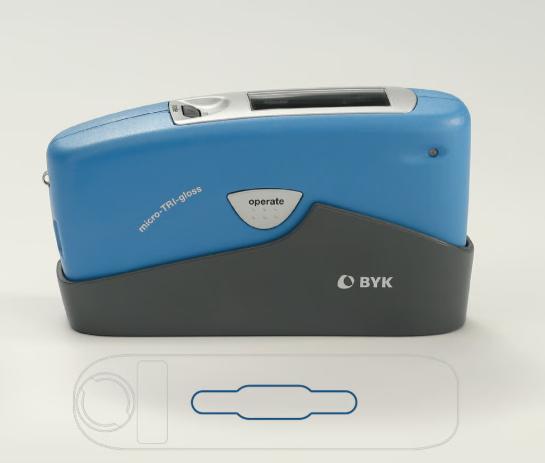
Quick answer: When buying a gloss meter, the biggest decision isn't "which brand" but how many angles you need: a single-angle 60° meter (like the micro-gloss) or a three-angle 20/60/85° meter (like the micro-TRI-gloss). Settle that first, then weigh features & software, standards, and calibration service. This guide walks the decision so you buy right the first time.
The core decision: single-angle or three-angle?
Gloss meters differ mainly in the number of measurement angles built in. That determines which surfaces the meter can handle — and whether it has "room to grow" as your product range expands:
- Single-angle (micro-gloss): measures at one angle — usually 60°. Compact, light, best value. Right when you measure one surface type around medium gloss and rarely change applications.
- Three-angle (micro-TRI-gloss): measures 20°, 60° and 85° in one placement. Right when you measure a range of surfaces — high-gloss to matte — or want one meter shared across the plant without buying another later.
| Criterion | micro-gloss (single-angle) | micro-TRI-gloss (three-angle) |
|---|---|---|
| Angles | One (20°, 60° or 85°) | All three 20/60/85° at once |
| Best when | One surface type, stable gloss level | Many surface types, need flexibility |
| Room to grow | Limited to one angle | Covers every gloss level |
| Upfront cost | Lower | Higher, but "one meter for all" |
Which specific angle suits which gloss level (20° for high-gloss, 85° for matte)? That's a separate question — see How to choose a gloss meter: 20°, 60° or 85°? to pick the right angle for your product.
Beyond angles: features, statistics and software
Once you've fixed the number of angles, compare the things that shape day-to-day QC: memory for readings, on-board statistics (mean, standard deviation, pass/fail against tolerance), and software connectivity for reporting. The micro-TRI-gloss adds memory, statistics and smart-chart connectivity so you can standardise QC and share data digitally with customers — instead of writing numbers down by hand.
Standards, calibration and service
Finally, make sure the meter supports the right standards (ISO 2813, ASTM D523, DIN 67530), ships with a calibration standard, and comes with calibration, warranty and local technical support. This is the big difference between genuine instruments and grey-market units (see: BYK-Gardner vs. Chinese gloss meters).
Recommended BYK-Gardner instruments at K&K
| Need | Recommended |
|---|---|
| Single angle, compact, best value | micro-gloss (20°, 60° or 85° single angle) |
| Three angles 20/60/85° in one reading | micro-TRI-gloss |
| Handheld colour + 60° gloss combined | Spectro2go / Spectro2guide |