
Quick answer: 45°/0° geometry means illuminating the sample at 45° and viewing perpendicular (0°). This layout excludes specular reflection (gloss), so the reading reflects colour as the human eye sees it under normal light.
How 45°/0° works
Light arrives at 45° while the detector sits perpendicular, capturing only diffuse reflection (true colour) and ignoring the specular "glare". So the number tracks the visual perception of colour and final appearance.
When to use 45°/0°
- Paints, coatings and surfaces where final appearance matters.
- Flat, matte or lightly textured surfaces.
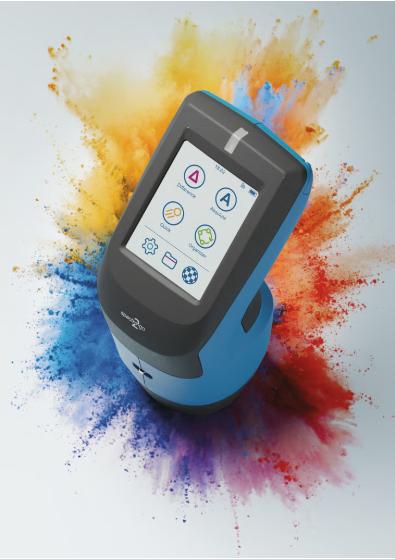
Many instruments such as Spectro2go offer a 45°/0° version. If you need flexibility to include/exclude gloss, see d/8° geometry and 45°/0° vs d/8°.
Frequently asked questions
Does 45°/0° measure gloss?
No — 45°/0° excludes specular reflection, so gloss doesn't affect the colour result; it reflects colour as the eye sees it.
Which industries use 45°/0°?
Paint, coatings, automotive and surfaces where final appearance matters.
How does it differ from d/8°?
d/8° uses an integrating sphere and lets you include/exclude gloss (SCI/SCE), more flexible for formulation and glossy samples.