
Quick answer: d/8° geometry uses an integrating sphere to illuminate the sample with even diffuse light and view at 8°. Its key advantage is letting you choose SCI (specular included) or SCE (specular excluded) — very flexible.
How d/8° works
The sphere floods the sample with light from all directions, reducing the effect of texture and shape. With a gloss trap, the instrument can include (SCI) or exclude (SCE) specular reflection.
When to use d/8°
- Formulation and colour control (SCI reflects material colour, independent of gloss).
- Glossy, curved, plastic or textile samples, or uneven surfaces.
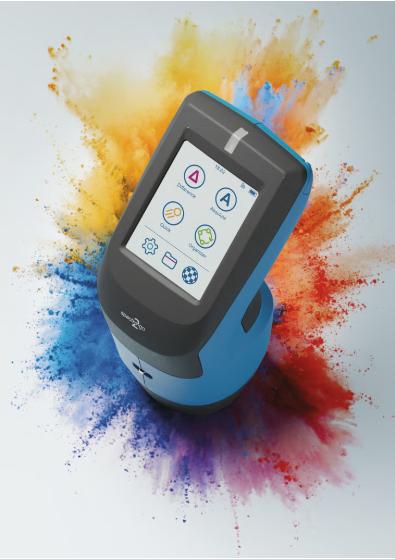
A d/8° version is available on instruments like Spectro2go. Compare directly in 45°/0° vs d/8°.
Frequently asked questions
What are SCI and SCE?
SCI includes gloss (controls material colour); SCE excludes gloss (reflects appearance as the eye sees it). d/8° can measure both.
Which industries use d/8°?
Formulation, plastics, textiles and glossy/curved samples — where SCI/SCE flexibility is needed.
Should I pick d/8° or 45°/0°?
Choose d/8° for SCI/SCE flexibility and glossy samples; choose 45°/0° when appearance-as-seen matters most.