
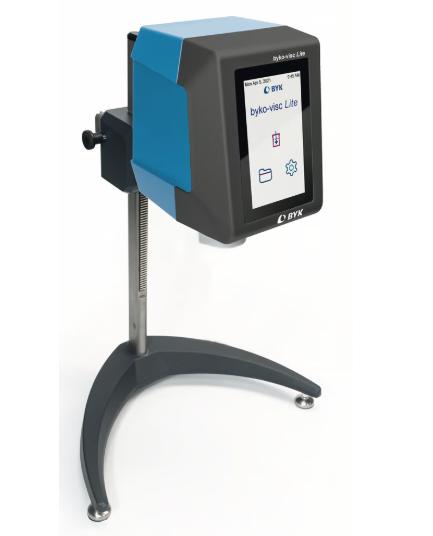
Quick answer: Viscosity cups (Zahn, Ford, ISO cups) measure flow time and suit thin, near-Newtonian liquids such as paint thinned for spraying, inks and primers. A Stormer viscometer measures Krebs Units (KU) per ASTM D562 and suits thicker, thixotropic paints such as in-can architectural paint. Many plants use both: Stormer in the QC lab, cups on the line.
How do viscosity cups work?
Fill (or dip) the cup, then time until the stream from the orifice breaks — the flow time (seconds) reflects viscosity. Common types:
- Zahn dip cups (ASTM D4212): dip into the container, lift and time — very convenient for quick checks on the line (see: Zahn cups).
- Ford cups (ASTM D1200) and ISO cups (ISO 2431): stand-mounted, widely used in labs.
Pros: inexpensive, fast, no power needed, easy to train. Limits: unreliable for non-Newtonian or thixotropic paints; depends on operator timing; orifices wear over time; very sensitive to sample temperature.
How does a Stormer (KU) viscometer work?
A Stormer rotates a paddle in the paint can at a fixed speed (200 rpm per ASTM D562) and converts the resistance into Krebs Units (KU). It measures directly in the can and suits thick and thixotropic paints — typical of most decorative water-based paints. A digital instrument such as byko-visc DS automatically displays KU, cP and grams over a 40–141 KU range, reducing operator error.
Quick comparison
| Criterion | Viscosity cups | Stormer (KU) |
|---|---|---|
| Result | Flow time (seconds) | KU (plus cP, g on digital units) |
| Best for | Thin, near-Newtonian liquids: spray-thinned paint, inks, primers | Thick, thixotropic paints: in-can water-based paint |
| Where used | Production line, field | QC lab |
| Standards | ASTM D4212, ASTM D1200, ISO 2431 | ASTM D562 |
| Operator dependence | High (timing) | Low (digital) |
| Cost | Low | Medium |
What about application viscosity?
KU reflects in-can consistency, and cups reflect flow at low shear. To understand how paint behaves when brushed, rolled or sprayed — at very high shear — use a cone-and-plate viscometer such as byko-visc CP (high-shear method, ASTM D4287). For a wider viscosity range, the byko-visc RT rotational viscometers are a flexible choice.
Practical tips on the plant floor
- Control sample temperature: viscosity changes strongly with temperature — in Vietnam's hot, humid conditions, measure at a fixed temperature set by the standard or your internal procedure.
- Don't rely on conversions: seconds ↔ KU ↔ cP tables are only indicative for Newtonian liquids and shouldn't replace measurement.
- Check cups regularly: worn or fouled orifices skew flow times.
A view from K&K Chemical
There is no single "best" instrument — only the right one for the product and the checkpoint. K&K Chemical distributes the full BYK-Gardner viscosity range, from Zahn cups to Stormer, cone-and-plate and rotational viscometers, and can advise on the right set-up for your QC lab and production line.