
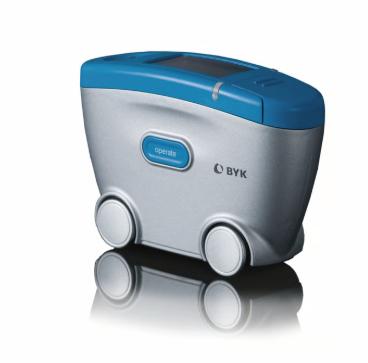
Quick answer: Metallic and effect coatings often develop "mottling" (clouding) — patchy light-and-dark areas caused by uneven distribution of aluminium/mica flakes. Judging it by eye is subjective and hard to repeat. BYK-Gardner's cloud-runner measures it objectively, helping control appearance quality for automotive, plastics and effect coatings.
What is mottling, and why does it happen?
In metallic/effect coatings, aluminium or mica flakes create sparkle and depth. When those flakes are unevenly oriented and distributed (from spray, viscosity, evaporation rate…), the surface shows light-and-dark patches — mottling or clouding. The defect often only appears at certain viewing distances and changes with angle, so it's very hard to catch consistently by eye.
Why the eye isn't enough
- Subjective: everyone rates "clouding" differently; hard to agree OK/NG with customers.
- Condition-dependent: lighting, distance and viewing angle change the verdict.
- No number: what you can't measure, you can't control across batches and plants.
How cloud-runner measures mottling
cloud-runner simulates how the human eye evaluates at different observing distances/angles and quantifies mottling by the size and visibility of the patches. It's small and light, scans across the surface with a variable scan length (up to ~100 cm), and operates via a scroll wheel with a multilingual display. The result is an objective number to set tolerances, compare batches and communicate with customers.
cloud-runner vs wave-scan: what's the difference?
The two complement each other for high-gloss appearance:
- cloud-runner → measures mottling/clouding (effect-flake distribution).
- wave-scan → measures surface structure (orange peel) and DOI (see When to measure DOI).
A view from K&K Chemical
For automotive paint, plastic parts and effect coatings, controlling mottling cuts rejects and appearance disputes. K&K Chemical — BYK-Gardner's distributor in Vietnam — demos cloud-runner on your effect samples, with calibration and genuine warranty.