
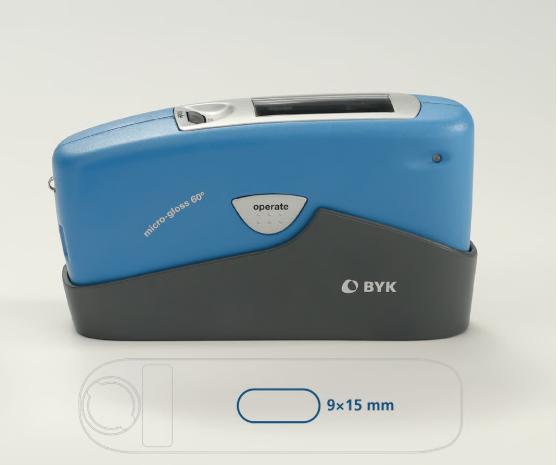
When you shop for a gloss meter, you'll find a very wide price range — from budget Chinese models to the noticeably higher cost of a reference-grade instrument like BYK‑Gardner. The real question isn't "which is cheaper", but "which gives a reliable, repeatable reading for what you actually need". This article helps you compare objectively.
The gloss meter market: many options, many prices
Gloss measurement has been standardized for decades (ISO 2813, ASTM D523), with three common geometries: 20°, 60° and 85°. Because the principle is the same, many manufacturers — especially from China — offer gloss meters at attractive prices. On paper, their specs look close to premium instruments. The real differences lie in what isn't printed on the brochure: accuracy held over time, agreement between instruments, and calibration quality.
The 7 criteria that really matter when choosing a gloss meter
- Traceability: can the reading be traced back to national/international standards? BYK‑Gardner calibrates against recognized master standards and supplies a certified calibration standard — essential when a customer or auditor asks for proof.
- Inter-instrument agreement: if the factory and the customer use two different meters, do the results match? This is where budget units often fall short, leading to "my meter reads differently from yours" disputes.
- Stability & temperature compensation: LEDs and sensors drift over time and with temperature. A good instrument compensates and self-checks to stay stable in a hot workshop.
- Repeatability: measure the same spot several times — do you get the same value? Low repeatability error is what lets you set tight QC tolerances.
- Calibration & regular service: is there somewhere in-country to calibrate, certify and repair it? Grey-market units rarely come with a clear warranty path.
- QC software & data management: the ability to store, export and trend data over time helps you catch a drift before it becomes a batch of rejects.
- Total cost of ownership (TCO): purchase price is only part of it. Factor in calibration cost, downtime when a unit fails, and the risk of a wrong reading causing a re-spray or a returned shipment.
A cheap gloss meter can give you a number. A reference-grade instrument gives you the right number — repeatable, and defensible when a customer disputes it.
When a budget meter is enough — and when it isn't
To be fair, a mainstream gloss meter can be fine if you only need quick, internal checks with no contractual color/gloss commitments and no need to compare results with a third party. For a rough "is it glossy or matte" answer, it does the job.
But if you ship to a customer's standard, supply automotive OEMs, need calibration certificates, or must guarantee consistent results across several plants or shifts, then inter-instrument agreement and traceability become requirements, not nice-to-haves. That's where a reference-grade instrument saves you money in the long run.
Why BYK-Gardner is the industry reference
BYK‑Gardner is one of the names many labs and OEMs choose as their master instrument for cross-checking. Its meters stand out for high inter-instrument agreement, good temperature control, certified calibration standards, and a mature QC software ecosystem. Put simply, when two parties argue over a number, the BYK meter is usually the referee.
micro-gloss and micro-TRI-gloss
For most paint, plastics and coatings applications, two popular choices are:
- micro-gloss 60° gloss meter — a versatile single-angle 60° version, ideal for semi-gloss surfaces and daily QC.
- micro-TRI-gloss triple-angle gloss meter — measures 20°/60°/85° at once, covering high-gloss to matte in a single reading.
Both include smart functions, temperature control and high instrument agreement. Browse all BYK-Gardner measurement instruments for a detailed comparison.