
Quick answer: Choose a coating thickness gauge by 4 things: (1) substrate — magnetic steel (Fe), non-ferrous metal (NFe) or non-metal; (2) non-destructive or destructive; (3) single or multilayer; (4) range and standard (ISO 2808).
1. Substrate decides the technology
- Steel (Fe): magnetic principle. Aluminium/copper (NFe): eddy current. Fe/NFe units auto-detect the substrate.
- Non-metal (plastic, wood, concrete) or multiple layers: need ultrasonic technology.
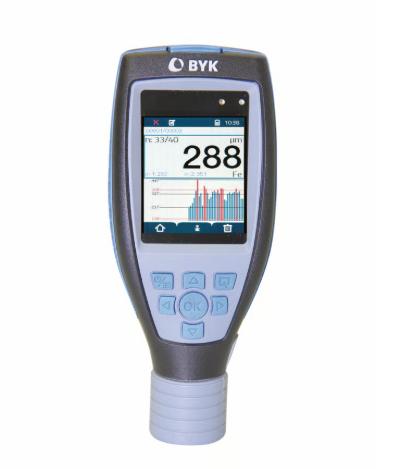
For example Byko-test 9500 measures Fe/NFe non-destructively; BYK-µPELT measures multilayer by ultrasound.
2. Non-destructive or destructive?
Non-destructive (NDT) is fast and leaves the sample intact — ideal for volume QC. Destructive methods (cross-section microscopy like Byko-cut) give a visual layer cross-section for verification.
3. Single or multilayer?
For total thickness on metal, magnetic/eddy is enough. For individual layer thickness (primer, base, clear) on any substrate, choose ultrasonic PELT.
4. Range & standards
Pick a range covering your product, suitable resolution, and compliance with ISO 2808 / ISO 2178 / ISO 2360. Prefer gauges with traceable calibration.