
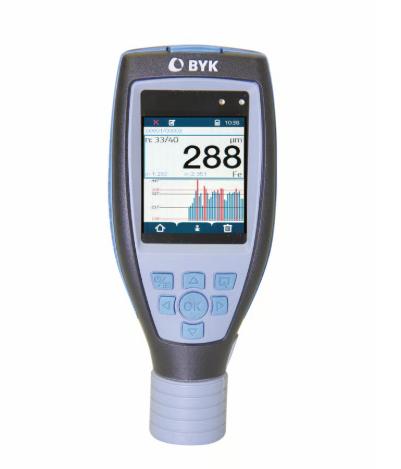
Coating thickness is the thickness of a paint or coating film on a substrate, usually measured in the dry state — known as DFT (dry film thickness) — in microns (µm). It is one of the most important coating properties: thickness governs corrosion protection, durability, appearance and even material cost.
Why control coating thickness?
- Too thin: insufficient protection, prone to corrosion, flaking, substrate show-through.
- Too thick: wasted paint, sagging, cracking, reduced adhesion and higher cost.
- Correct thickness meets the customer's spec and optimises paint consumption.
How is coating thickness measured?
The most common method is non-destructive, with a probe placed on the surface:
- Magnetic induction: measures non-magnetic coatings on a ferromagnetic substrate (steel, iron).
- Eddy current: measures insulating coatings on a non-ferrous substrate (aluminium, stainless).
A two-in-one gauge (Fe/NFe) auto-detects the substrate and selects the right method. For non-metal substrates (plastic, wood, concrete), ultrasonic or optical cross-section methods are used.
Coating thickness standards
Non-destructive measurement follows ISO 2808, ISO 2178 (magnetic substrates), ISO 2360 (non-magnetic substrates) and ASTM D7091. The gauge must be calibrated on the matching standard and substrate for accuracy.
BYK-Gardner coating thickness gauges at K&K
| Need | Instrument |
|---|---|
| Thickness on steel & aluminium (Fe/NFe) | byko-test FeNFe |
| Basic, everyday gauge for field QC | byko-test 9500 Basic |
Not sure which to pick? See How to choose a coating thickness gauge.