
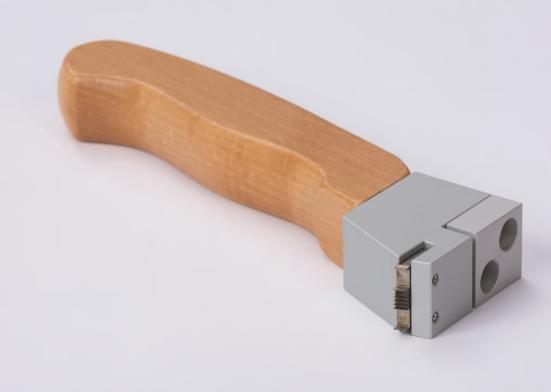
A cross-cut (cross-hatch) adhesion test assesses how well a coating adheres by cutting a grid of squares through the paint film down to the substrate, applying then removing a standard tape, and classifying how much coating detaches on a graded scale. It is a fast, cheap and standardised way to check whether paint is firmly bonded to the substrate — a key coating-quality property.
How is a cross-cut test performed?
- Use a multi-blade (cross-cut) cutter to make a series of parallel cuts through the coating to the substrate.
- Make a second set of cuts at right angles to form a grid of squares.
- Clean the area, apply a standard tape over the grid, then peel it off at the specified angle.
- Classify the detachment on the ISO Gt0–Gt5 scale (Gt0 = best adhesion) or ASTM 0B–5B (5B = best).
Choosing blade spacing: 1mm, 2mm or 3mm?
The spacing between cutting teeth is chosen by film thickness and substrate:
- 1 mm — thin films (≤ 60 µm) on hard substrates.
- 2 mm — medium films (60–120 µm).
- 3 mm — thick films (120–250 µm) or soft substrates.
Choosing the right spacing per the ISO 2409 table keeps the classification reliable.
Which standards cover the cross-cut test?
The two most common are ISO 2409 (Gt0–Gt5 classification) and ASTM D3359 (method B, 0B–5B classification). It's part of the coating physical testing family, alongside impact, bend and hardness tests.
BYK-Gardner cross-cut kits at K&K
| Need | Kit |
|---|---|
| Thin films on hard substrates (11 teeth, 1 mm) | Cross-Cut Kit 11×1 mm |
| Thicker films (6 teeth, 2 mm) | Cross-Cut Kit 6×2 mm |
Frequently asked questions
What is a cross-cut test?
A cross-cut (cross-hatch) test assesses coating adhesion by cutting a grid of squares through the paint film to the substrate, applying and removing a standard tape, then classifying how much coating detaches on a scale (ISO Gt0–Gt5 or ASTM 0B–5B).
How do I choose the blade spacing (1mm, 2mm, 3mm)?
The spacing between cutting teeth is chosen by film thickness and substrate: thin films on hard substrates use 1mm; thicker films use 2mm or 3mm, per the table in ISO 2409.
Which standards cover the cross-cut test?
The most common are ISO 2409 (Gt0–Gt5 classification) and ASTM D3359 (method B, 0B–5B classification).